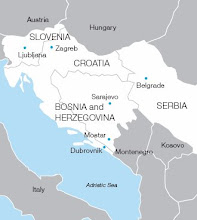
On Wednesday, I departed Zagreb for Bosnia. We stopped for lunch and a lecture in Banja Luka, which is the capital of the Republika Srpska (RS, the Serb-populated entity of BiH). After that, we got back on the bus and headed on to Sanski Most, where we spent the night.
Non-Serbs were expelled from Sanski Most during the war. Not many have returned, although much of the diaspora comes back to visit their town in the summertime. There wasn't too much there, except for a few cafes (as usual).
We were met by Vahedin, who runs the Center for Peace Building in Sanski Most. He is also an imam (Muslim religious leader). He is a great guy. His work includes creating a dialogue between the different ethnic groups in Sanski Most and in BiH. Every summer, they run peace camps, where people can come together to meet and process their feelings about the past. The Center also does year round club activities for youth, including foreign language classes, sports teams and other activities. They also provide psychological support and other counseling to people.
Vahedin took us to the mosque in the town and then we went up to the Center, which is in an old house (that he purchased for US$125... the annual budget of the center is US$10,000). Along the way, he talked a lot about his past and about Islam. He lived as a refugee in Slovenia for 4 years during the war. He also talked about hate and how it doesn't affect the people you hate, because they don't know you hate them - its a burden that only affects you.
The next morning, Vahedin ran a workshop with us on identity that he usually does at the peace camps. It was really interesting - it was hard for me to finish the exercise and I can only imagine what it would be like for someone who is really conflicted about their identities.
After a lunch of Bosnian stew, we got back on the bus for 5 hours and ended up in Sarajevo (finally! The city I came to see!). We had a long ride through the mountains and saw some pretty depressed (economically and otherwise) little villages. There were a lot of houses that were abandoned and had "Prodajem se" ("I'm selling") and a cell phone number spray-painted on the outside. But, the mountains were really pretty and there is still snow in most places (it was snowing here in Sarajevo today!).
Friday, March 20, 2009

Bosnia and Herzegovina: Info
Here is some information on the government and society of Bosnia and Herzegovina (BiH). It will help you in understanding my posts about my travels through the different regions here and to know what I'm learning about.
BiH declared independence from Yugoslavia in 1991. From 1992-1995, the country was wrought with inter-ethnic conflict, including genocide, mass rape and other war crimes. Many towns were ethnically cleansed and the city of Sarajevo was sieged by Serb forces from 1992-1996. Mass killings occurred in Srebrenica in 1995. A lot of numbers get thrown around when casualities are discussed, but I think it's around 100,000 people, over half were civilians. There is no man or woman living in BiH today who was not affected by the wars of the 1990s in some way.
The Dayton Peace Accords signed in 1995 set up a peace agreement, the constitution of BiH and a framework for the government. It's under a lot of criticism here, because essentially, Dayton gives every party a share of power, but it doesn't, in reality, function. BiH currently spends more per capita on the government than any country in Europe. The GDP per capita is $6,600 (in the United States, its $48,000).
BiH consists of 2 states within BiH: the Republika Srpska (RS) and the Bosnian/Croat Federation. Bosnia and Herzegovina are just geographical terms. RS consists of a mainly Bosnian Serb population, divided into municipalities. The Federation is decentralized into 10 cantons (counties), which are either ethnically Muslim, Croat, or mixed. The cantons are further split up into muncipalities. Each level of government has different functions, which are too confusing to explain here. On the map, the gray area represents the RS, while the lighter areas represent the Federation.
Going along with these ethnically divided regions, other things are similarly shared among the groups. For example, the Presidency consists of elected Muslim (or "Bosnjak"), Croat and Serb officials - they rotate through the Presidency every 18 months. Political parties also function based on ethnicity. In the bicameral parliament, legislation is easily rejected if a member feels it could infringe on their ethnic rights.
That is sort of a crash introductory statement to the state of BiH. It probably doesn't make much sense, it's really hard to understand. Just know that reform of the current constitution is necessary. It is predicted that without a change in course, there will be more conflict in BiH.
Tuesday, March 17, 2009
Venice Photos!
 |
| Venice |
There are a lot of pictures of bridges and canals, so prepare yourself. Also, I don't have time to caption all of them, so I apologize!!
Bosnia-Herzegovina Itinerary
We leave for Bosnia and Herzegovina (BiH) tomorrow morning! Our itinerary is the following:
Wednesday: Day in Banja Luka, travel to Sanski Most.
Thursday: Day in Sanski Most, travel to Sarajevo.
Friday-Monday: Sarajevo!
Tuesday: Travel to Mostar, day there.
Wednesday: Travel to Dubrovnik and have a few hours free time there.
We fly back to Zagreb from Dubrovnik on Wednesday night. I'll definitely have internet at some point in Sarajevo, so I'll update then! We spent yesterday and today discussing BiH after the Dayton Peace Accords and the current political system there. Hopefully, I'll find the time to write a post explaining all of it to you, dearest readers.
Sretan Irski Dan!
Also, happy birthday Spencer and happy belated birthday Mom!!
Monday, March 16, 2009
VENEZIA!!
Wow. What a beautiful city!! It was altogether peaceful and calm and quiet - so relaxing!
Rachel and I left Friday night. We took an overnight train from Zagreb to Venice. We left Zagreb at 11:30 and arrived around 7:15am. It wasn't direct, plus we stopped for 45 minutes at every border (Slovenia and Italy), so it took awhile. Luckily, we were able to sleep for a few hours.
We arrived in Venice and went straight to our hostel (Absolut Venice). It was located right across the canal from the train station and it was really easy to find! The manager, Franco, was already awake and he made us coffee and gave us some cake for breakfast. The hostel was beautiful - it had chandeliers and moldings and MTV!
After our cake and coffee with Franco, we hit the streets. The city is spread out over a bunch of islands, which have canals and little windy streets running all through them. Everything (at least on the islands connected by bridges) is within close walking distance, so we found most of the major sites by early afternoon. We got to San Marco's Basilica shortly after it opened and walked right it - by the time we came out, there was a line stretching around the square!
Plenty of tourists were out, but probably nothing compared to what it's like during the peak season. Also, there are no cars on the islands, making it really different from Zagreb and Belgrade! It was nice to know that we weren't going to be nearly killed at every corner! The lack of air pollution was very welcome. The weather was warm and sunny (but not too hot that we could smell the canals).
We stopped for pizza at a little trattoria and had excellent, polite service from a few Italian guys who thought we should join them later on that evening for some street dancing. We passed... After some gelato, we eventually made it back to the hostel, where we napped for a few hours since we hadn't gotten the best night's sleep on the train.
After our power snooze, we went to the Venetian Ghetto and ended up at a major grocery store (the selection there was sort of reverse culture shock!). We bought some pasta and such for dinner and went back to the hostel to cook it. I haven't cooked for myself since January! It was so nice to be free in a kitchen without a host mom trying to prepare something for me! We were also able to buy tomatoes, which are a rarity this time of year in Croatia. In the market, only one or two vendors have them and then, they are really expensive.
We went to bed pretty early - there were a few other people at the hostel (2 girls from Canada and a few kids from China), but everyone was pretty quiet/tired. Sunday morning, we woke up and packed up our stuff. Franco said we could leave our backpacks in the closet and invited us back for dinner that night, which was really nice.
We saw some more sights and had cappucinos at an outdoor cafe on one of the squares. I wish I knew more about Italian history, because I think I would have understood the significance of some of things we were seeing better. I wanted to go on a guided tour, but we really weren't up for it and didn't want to shell out the Euros! I have a little guide to the city, so I'll just have to read it as I look at my pictures; hopefully, it will all make sense.
We got kebabs (I know, not Italian, but we needed something flavorful and not the bland meat they serve in Croatia) and ate them on the promenade along the Grand Canal. After more gelato, we went souvenir shopping! Murano glass (a Venetian original) was everywhere. I bought a pair of earrings and a glass pendant for a necklace. I really wanted a Carneval mask, but needed to prioritize/budget!! After that, we bought some drinks (Bellini for me) and went to a park to sit and relax... our feet were killing us! Then, we went to the hostel for dinner and to get our stuff.
We left Venice at 9:30, had some time to read/do homework on the train before we got to the border and then we slept until 4am, when we arrived in Zagreb. We went back to Rachel's apartment and slept for 5 hours before class! It was a fantastic trip!!
My pictures will be up sometime in the next 24 hours.....
Wednesday, March 11, 2009
I miss my friends... / Serbia Reflection
...as crazy as they are.
I've got 3 of my very best friends on speakerphone over Skype. I miss them so much! I love listening to them. Even though we're discussing housing for next year (our housing lottery is next week)... it's great. My voice is really hoarse and I'm trying not to talk too loud, because everyone else is asleep, but I'm not hanging up because I haven't had a phone conversation with anyone at CUA for a long time!
We got back from Belgrade safely. It was a good trip. I'm pretty beat now, but that might just be because its 1:15am. I didn't unpack either, because I only took my backpack, some clothing and my senses to Belgrade, so there isn't anything to unpack anyways.
***
I had to deal with some awkward questions when I walked in the door. Branka was home and she was so happy to see me! She made me some tea and we sat in the living room, where the guys were watching soccer (per usual). The kids wanted to know which I liked more, Zagreb or Belgrade? (I lied). I knew in coming back, I'd have to answer a lot of questions about what I thought about Serbia/ns, especially from Slavan. He asked me right away if "I killed some Serbs" (he wanted to give me a knife for that before I left, remember?). He asked me something about the Shiptars (the derogatory term for the Roma). Also, he asked me who I thought was "guilty" for the wars.
I can awkwardly laugh off the question about killing Serbs, that is just silly to me. The question about the Roma I didn't quite understand and all I heard was "Shiptar," so I'm blowing it off. The question about who is "guilty" is another issue all together. I should have just told Slavan it was the Serbs' fault, it would have made things much easier. I tried to say that as an American, as an outsider, it wasn't my place to determine guilt or responsibility. That didn't go over well at all. He started yelling that I was an anthropology major! That I studied these things! That I should realize what the Serbs did to the Croats! Really, Slavan, the wars of the 1990s started because of many reasons, on many different fronts. It isn't reasonable for me to answer that question.
I think that is what I liked so much about Serbians. They didn't try to deny their role in the wars. The people I talked to admitted that Serbia was the bigger power, thus holding a greater responsibility. They pointed out that war crimes were also committed on other sides and reminded me that the entire Serbian system (political, economic, social) collapsed. They are still faced with the consequences today. Economically, they are farther behind Croatia and the global recession is hitting them hard. Politically, everything is corrupt. An interviewee stated to me, "It was better in the '90s, because then you were clear who the opposition was. Today, you just don't know. You can't trust anyone." Serbians still need visas to travel, which limits the people's interaction with the greater global community (I think that this is detrimental, because it prohibits young people from going out into the world to experience other modes of organization and frames of meaning... something that would definitely help Serbia's society to evolve).
I don't really know what the solution is or what I should have answered. It leaves a bad taste in my mouth when you're running around telling people that all Serbs are bad (especially your kids - who will eventually pick up the pieces of something they aren't collectively responsible for). Not all Serbs are bad, not all Croats are good.
Next week, I get the Bosnian perspective(s). I guess that I should rest up.
Wind blows on...
I had my last night in Belgrade... it was good. I finally got lost. This is different than getting lost in other cities. There are no maps. No street names. If a street has a name, it's written in Cyrillic. Chances are, the name has also been changed at least three times. It was an epic adventure.
I was trying to get to Jacob's apartment by 8:00 for a little sending off dinner with everyone. I had it in my head that he and I lived on opposite ends of the 26 bus line, so I thought it would be a pretty easy trip. Not so.
I ended up at the end of the 26 line in Dorćol, texting Jacob - "I think I'm lost." This was at 7:50. Apparently, Jacob doesn't live on the 26 bus line, he lives on the 28 - who knew? So, I got back on the 26, went half way back to my house, and got off at the law school. There, I asked some people for directions to the bus stop for 48 or 33, and they directed me to the center median of the cross street. How Belgrade traffic patterns function, I'll never know.
After waiting many minutes for the bus to come, I took it to the "third stop" like I was directed... it was the middle of some random intersection. I called Jacob's apartment so someone could come find me. I waited and waited and waited. Yes, I was at the wrong intersection...
At this point, I was hungry and cold enough to just head home. So, I crossed the street and walk a few blocks to the the bus station heading back to the law school. I called Rachel and said that I was in Cvijićeva and giving up.
When I got back to the law school, Danjiela (Jacob's host mum) calls and said that I absolutely need to come because she had information for me about her Roma projects. Talk about dangling the carrot. I turned around, got back on the 48 bus "headed down the hill" and this time, counted the law school stop as the first of three stops (which is what I messed up the first time)... and get off at Cvijićeva...
I finally made it to Jacob's at 10:00. I was never really lost. I ALWAYS knew where I was, I just had no idea where I was going (which is an analogy for my life in general).
Luckily, it was a beautiful (but cold) night. It was completely clear and there was a full moon. The Koshava wind was blowing up from the south, which, in my opinion, makes the city air feel less polluted.
Today, it's back to Croatia... wind blows on...
Subscribe to:
Posts (Atom)